

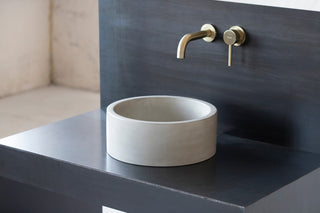
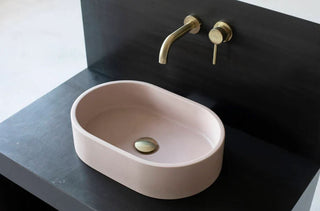

The bathroom has undergone an impressive transformation in modern architecture. Once a purely functional, often sterile space for daily hygiene, it is now seen as an integral part of the living area. We speak of a “wellness oasis” or a “private spa.” In this context, one particular sanitary fixture has become a favorite among architects and interior designers: the countertop washbasin.
But what makes this type of washbasin so special? Why is concrete the material of the moment when it comes to exclusive bathroom design? In this comprehensive guide, you will learn everything about the advantages, selection, and aesthetic impact of countertop washbasins—and why you shouldn’t compromise when planning.
What is a countertop washbasin?
Technically speaking, a countertop washbasin is a basin whose body is fully mounted on a supporting surface—usually a vanity top or cabinet. Unlike a traditional built-in sink, which is recessed into the surface, or a wall-mounted sink that hangs independently, the entire outer shape of a countertop washbasin remains visible.
The connection to the base unit is typically made through a single opening for the drain. This gives designers enormous creative freedom: the basin can be positioned centrally, offset, or combined as a double vanity. Especially with materials like concrete—crafted with high precision by Betono.shop — the washbasin becomes a standalone design object within the space.
What are the advantages of a countertop washbasin?
Choosing a countertop washbasin is often driven by aesthetics, but its benefits go far beyond appearance:
1. Aesthetic excellence and individuality
The greatest advantage is undoubtedly its visual impact. A countertop washbasin breaks up the horizontal lines of the bathroom and introduces a vertical accent. Since the outer surfaces are fully visible, textures and colors become far more pronounced. A handcrafted concrete basin, with its distinctive tactile quality, immediately draws attention.
2. Tailored ergonomics
With standard sinks, the height is often predetermined. However, since a countertop washbasin is installed on a surface, you can define the height of that surface individually. This is a significant comfort advantage, especially for taller or shorter individuals. The upper edge of the basin can be precisely adjusted to the ideal usage height.
3. Increased storage space
With built-in sinks, the basin body occupies valuable space inside the vanity unit. In contrast, a countertop washbasin only requires space for the drain pipe (siphon) within the cabinet. This leaves considerably more room in drawers or compartments for towels, cosmetics, and other bathroom essentials.
4. Flexibility in material selection
Since the washbasin does not merge with the cabinet, it allows for striking material contrasts. A rustic wooden countertop combined with a cool, silky-smooth concrete basin from betonoshop.de creates a balanced aesthetic that feels both modern and inviting.